Paris Photo 2025: Spotlight on Eve Arnold and Myriam Boulos
Interviews with Myriam Boulos and Magnum Gallery’s Senior Manager Clemence Vichard-Larroque on the images selected for Elles x Paris Photo 2025
Elles × Paris Photo, in partnership with the Ministry of Culture, is a selection at Paris Photo dedicated to women photographers and their influence on both the evolution of photography and the medium today. This year’s curation explores the relationship between figure and setting, revealing “plural ways of inhabiting the world, of occupying space, of asserting a presence or, on the contrary, of erasing it,” the organizers write.
This year’s curator, Devrim Bayar, has selected two images by Magnum photographers: Eve Arnold and Myriam Boulos.
Below, Clemence Vichard-Larroque, Magnum Gallery’s Senior Manager, shares her insight into Arnold’s 1954 photograph taken in Havana, Cuba and the photographer’s long-term investigation of women’s lives, followed by an interview with Boulos, who discusses her approach behind her image of a female activist in Beirut.
Eve Arnold
Can you tell us the story behind this photo? What technique did the photographer use? What was she saying through this image?
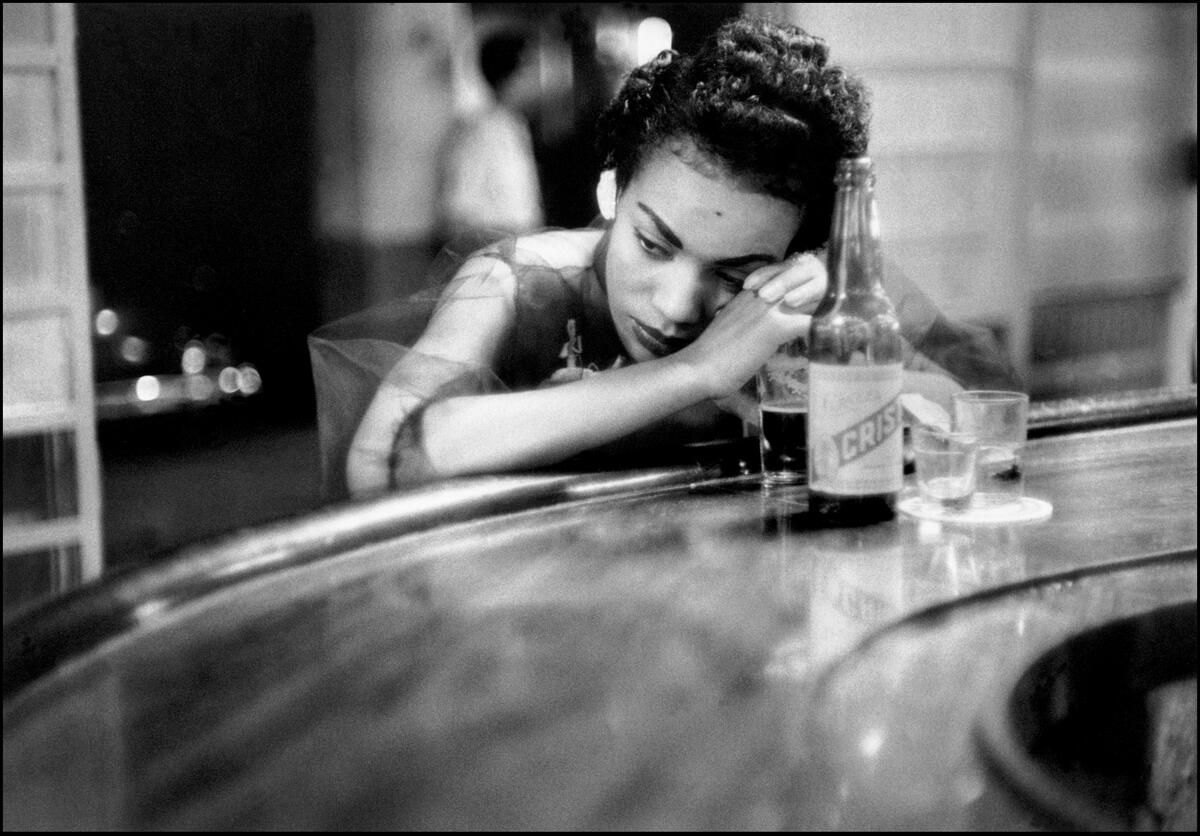
This photograph was taken by Eve Arnold in Havana, Cuba, in 1954, during one of her early assignments for Magnum Photos. It shows a young woman sitting alone at a bar in Havana’s red-light district, her head resting on her arm beside a bottle and a glass. At first glance, it might be mistaken for a film still or one of Arnold’s backstage portraits of a celebrity, yet what she truly captured here is a moment of quiet isolation, imbued with a haunting beauty. Arnold’s approach was grounded in careful observation and subtlety. She moved silently and instinctively, adapting to unpredictable conditions and using them to her advantage. The image feels spontaneous and unposed, reflecting her humanist sensibility.
As her colleague Henri Cartier-Bresson once said of portraits, “I am looking for the silence in somebody,” a quality Arnold captured time and again. Here, she allows us to witness an intimate, contemplative moment in a noisy, male-dominated world. The photograph exemplifies her empathy, attentiveness, and remarkable aesthetic sense, guiding the viewer’s eye naturally to the subject and her quiet, poignant humanity.
Through this image, and across her body of work, Arnold explored the inner lives of women with extraordinary insight. In her book, The Unretouched Woman, she expressed her desire to understand and portray women across the globe: “I photographed girl children and women; the rich and the poor […]. I am a woman and I wanted to know about women.”
Do you think female photographers tend to express themselves differently than male photographers?
When it comes to photography, women can bring a uniquely empathetic perspective to their subjects, particularly when photographing other women, and Eve Arnold’s work exemplifies this beautifully. As she wrote in The Unretouched Woman, Arnold sought to show “how it feels to be a woman, seen through the eyes and the camera of one woman — images unretouched, for the most part unposed, and unembellished.” In doing so, she was both observer and participant, drawing on her own experiences to connect with the women she photographed.
Arnold explained, “I know something of the problems and the inequities of being a woman, and over the years the women I photographed talked to me about themselves and their lives. Each had her own story to tell — uniquely female but also uniquely human.”
Through this approach, women photographers often emphasize authenticity and the truth of human experience over power, performance, or external appearance. Arnold’s portraits reject idealization and glamour, instead revealing the complexity, strength, and vulnerability of her subjects. Unlike many male photographers of her time, who might approach their subjects with distance or control, Arnold worked through connection, trust, and empathy, allowing her subjects to be seen honestly and fully.
What do you think it was like for an American woman to be photographing in Cuba in the 1950s?
Photographing in Cuba in the 1950s as an American woman brought both challenges and opportunities for Eve Arnold. Under Batista’s dictatorship, Cuba was marked by corruption, poverty, and social inequality, creating a complex and sometimes risky environment. At the same time, photojournalism was overwhelmingly male-dominated, and Arnold was often seen as an outsider. When she joined Magnum in the early 1950s, she frequently encountered patronizing attitudes, but she decided to turn her gender into an advantage. As she explained, if being a woman was going to shape her career, she might as well embrace it: “Why not be myself? It turned out to be the wisest decision I could have made.”
Her perspective as a woman ultimately gave Arnold unique access. She could move quietly, observe sensitively, and earn the trust of women in bars, brothels, and other spaces where they were often overlooked or judged. Her photographs from Cuba capture deeply human stories of dignity, isolation, and resilience. Reflecting on her life’s work, she said, “I have been searching for myself, my time, and the world I live in.” It was this pursuit of truth, identity, and connection that defines her photography and gives it a timeless quality.
Myriam Boulos
Can you tell us the story behind this photo? What technique did you use? What are you saying through this image?
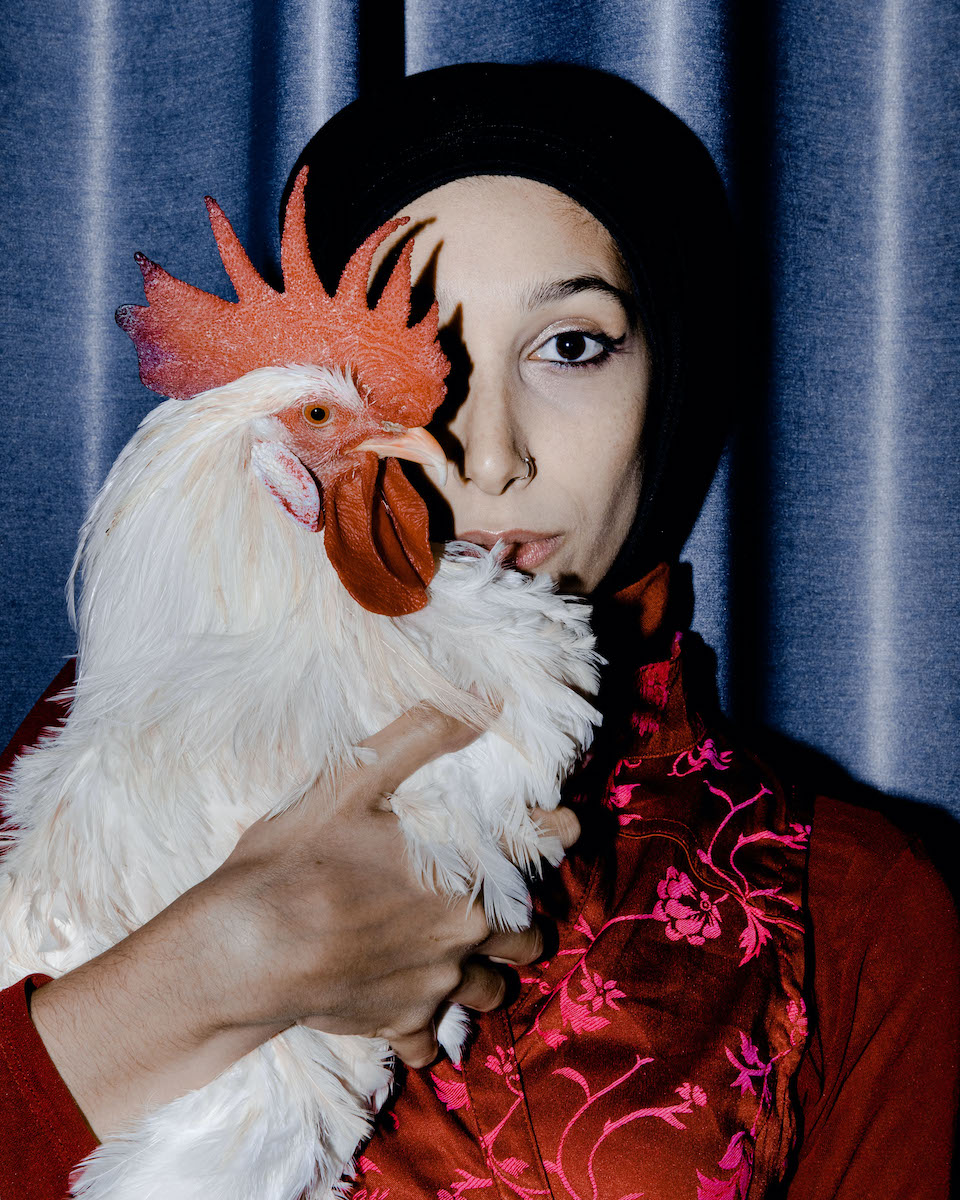
This picture was taken on November 29, 2023. Fawzia, a vegan activist and photographer, lives with Deeko and Lucie, a rooster and a hen. Fawzia told me: “I have loudly denounced the label of terrorism given to my people for as long as I can remember. I am tired of having to constantly defend myself and my religion.”
The image is part of an ongoing series called “Still,” which looks for tenderness in personal stories. This collective diary documents the intersectional oppression on our bodies and land. It attempts to create a space for our emotions and desires while denouncing different forms of violence, especially Israel’s aggressions on Lebanon and its genocide in Palestine. I used my digital camera Canon 5D mark IV and a direct flash. I wanted to listen to Fawzia’s personal experience in this collective history we are experiencing.
Do you think female photographers tend to express themselves differently than male photographers?
I think that most women question and deconstruct things, their place and approach in life and photography. Not so many men do this, especially cis, straight, white neurotypical men.
How do you approach the representation of women’s lives and the way they occupy space? What does it mean to represent women outside of the male gaze?
What I try to do is to listen to the people I photograph. One of the things that interests me in photography is the image as an encounter.
To represent women outside of the male gaze means to not have preconceived ideas about what and who we are photographing, and not to reduce people to stereotypes and symbols. It means to see every person we meet as their own creature and planet.

Photographing 70 years apart, Arnold and Boulos’s receptive approaches have provided an unfettered territory for women to inhabit their identities and emotional complexity in the distinct political contexts of their time.
These images featured in Elles x Paris Photo 2025 also contribute to the wider visibility for women photographers; since it began in 2018, the program has increased the representation of women artists at the Fair from 20% to 39%. Find this special focus on the printed map distributed at the entrance of the Fair or online.
Plan your visit and explore the Magnum Gallery curation at Paris Photo 2025 here.